Electric trucks in long-haul transport – an interim assessment
By Marcus Schick I 5 minute read
05/02/2026
Electric trucks are increasingly proving their worth in long-distance transport. COO Road Logistics Alexander Tonn takes stock of the situation so far: impressive mileage, current challenges, economic aspects, and growing acceptance among drivers, customers, and partners.

What experience has DACHSER gained with electric trucks in long-haul transport so far?
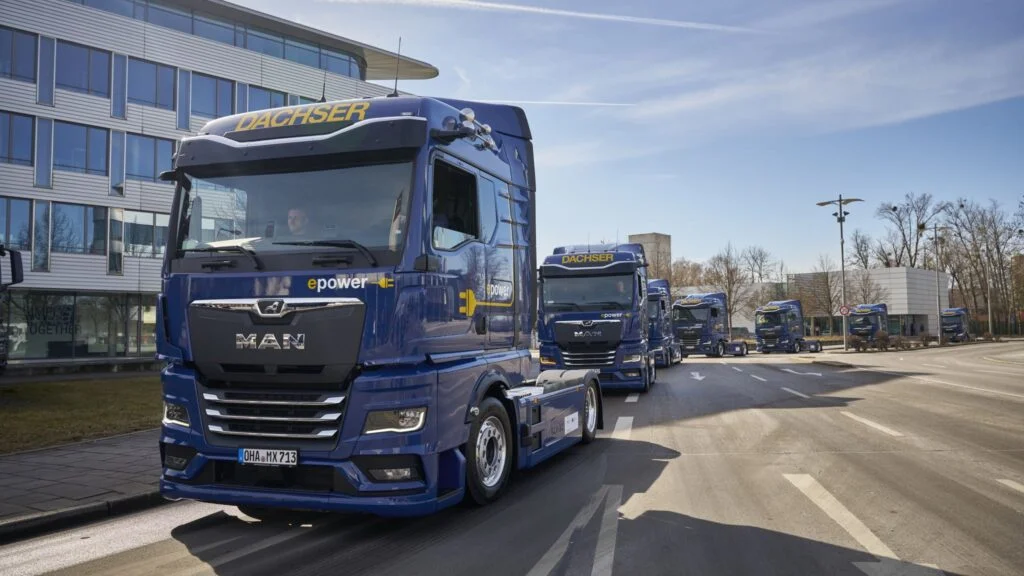
The transformation process in road freight transport is only just picking up speed, especially when it comes to long-haul transport. Several commercial vehicle manufacturers have only been producing heavy electric trucks with a range of around 500 kilometers in series production for a few months. DACHSER, for example, is one of the first customers for the MAN eTGX Ultra-Lowliner and the eActros 600 from Mercedes-Benz Trucks. The first series models were delivered to us at the end of 2024 and beginning of 2025. We are working closely with various manufacturers on the development of the vehicles, sharing our requirements and experiences, because the vehicles must fit seamlessly into everyday logistics operations.
And is it working?
Yes, we can now see that it is working well and that electric trucks are also proving themselves on long-haul routes. One of the new MAN Lowliner trucks has already covered over 130,000 kilometers, with an average daily mileage of around 800 kilometers. A Volvo FH Electric, which has been in use for some time, has already clocked up 240,000 kilometers in a year. Such mileage is extremely important on our path to gradually decarbonizing long-distance transport.
In the DACHSER network, we have regular and therefore very predictable transport routes between our branches. This means we can already use electric trucks on some important main routes, for example for various connections in North Rhine-Westphalia or from Würzburg to Frankfurt, from Berlin to Dresden, or across borders, such as from Hof to Kladno in the Czech Republic.
It is just as important that the vehicles are now very well received by drivers, as there were certainly skeptical voices at the beginning. E-trucks are also very popular with customers.
240,000
A Volvo FH Electric at DACHSER has already clocked up 240,000 kilometers in a year, for example.
At the Karlsruhe logistics center, several long-range electric trucks are already covering 400 to 600 kilometers during the day and night shifts.
Are electric trucks already a fully-fledged replacement for diesel trucks?
There is no blanket answer to this question. Our branches are looking very closely at where the use of an electric truck already makes economic sense today and how this can be reflected in day-to-day business. The vehicles must be suitable for the route and charging facilities must also be available.
However, the Karlsruhe logistics center shows that a lot is already possible. Here, several long-range electric trucks are already covering 400 to 600 kilometers during the day and night shifts. This provides us with important experience that benefits the entire network.
DACHSER received the Eco Performance Award in fall 2025 for its strong commitment to electromobility and its long-term strategy to reduce CO₂ emissions across its logistics network.

Where are the sticking points?
One challenge for electric trucks in long-distance transport is still the public charging infrastructure, although there is increasing movement in this area as well. Our Dortmund branch, for example, uses a public location of the Milence charging network on the A2 near Recklinghausen. Among other things, e-trucks traveling to our Dutch location in Zevenaar can charge here. Overall, however, there are still too few charging points for e-trucks on the highways. Accordingly, the focus is on charging at our branch when planning and implementing routes.
Charging speed is also an issue that needs to be optimized in order to make battery-electric vehicles even more suitable for everyday use. One step forward in this regard is the Megawatt Charging System (MCS) standard, which is set to replace the previous Combined Charging System (CCS) standard. This would allow electric trucks to be sufficiently charged during the mandatory break times.
Are electric trucks more expensive to operate than diesel vehicles?
For DACHSER, as a private company, the economic use of vehicles is naturally a decisive factor. And in long-distance transport, toll savings can already make economic operation possible in selected cases. As a general rule, the higher the range of a vehicle, the higher the purchase and leasing costs. Electric trucks are still about twice as expensive as diesel vehicles.
The total operating costs of electric trucks also have to take into account the very high investment costs for the charging infrastructure. The ratio of the number of vehicles to the number of charging points also plays a decisive role here.
At DACHSER, we sense a spirit of optimism and great momentum when it comes to electromobility.
Looking to the future, will we soon see many more electric trucks on our federal highways and motorways?
At DACHSER, we sense a spirit of optimism and great momentum when it comes to electromobility. Our branches are working very hard to be ready for the future and to be able to offer customers emission-free transport. We therefore assume that the number of electric trucks on the road for DACHSER will continue to rise steadily.
We are also seeing exciting developments here among our service partners. In the past, we had to do a lot of persuading when it came to battery-electric vehicles. But that has changed: transport companies are now very interested in adding electric trucks to their fleets and are approaching us with their own initiatives.
Overall, our impression is that battery-electric drives are also gaining ground in long-distance transport. A few years ago, this was not foreseeable, and we assumed that other drive technologies, especially hydrogen, would be necessary for longer distances. At the time, we did not expect electric trucks to be so easy to use.