Interview: What the new EU packaging regulation (PPWR) means for logistics
By Melanie Guggenberger I 5 minute read
18/09/2026
As of August 12, 2026, the EU’s Packaging and Packaging Waste Regulation (PPWR) imposes new requirements on companies and the logistics industry. With this regulation, the EU has established a legal framework designed to make packaging more sustainable along the entire value chain.

The PPWR aims to reduce packaging waste, promote reusable packaging solutions, improve the recyclability of packaging, and further harmonize requirements within the European Union. In this interview, Moritz Roeben, Corporate Legal Counsel at DACHSER, explains the impact the regulation will have on packaging management, verification requirements, and logistics processes, as well as how DACHSER is preparing for it.
Mr. Roeben, what does the European Union’s new packaging regulation mean for logistics?
The PPWR affects the entire packaging value chain and, consequently, logistics as well. It’s becoming more important than ever for companies to clearly define their role and to be able to trace the origin of the packaging they use, as well as to identify what information and verification is available regarding it.
The specific obligations that apply to a company depend on its role in the supply chain—that is, on whether it manufactures packaging itself, imports it, places it on the market under its own name, fills it, distributes it, or is another economic operator using it solely as part of logistics processes. What this calls for in practice is above all clearly defined responsibilities, reliable information from manufacturers and suppliers, and structured documentation.
By involving suppliers early on, systematically collecting verification, and fostering close collaboration among various departments, DACHSER is already laying the groundwork for the successful implementation of the PPWR.
What does the PPWR mean for DACHSER specifically?
DACHSER adapted to the requirements of the PPWR early on. One current priority is to systematically record and maintain access to the information and verification provided by manufacturers and suppliers regarding the packaging that DACHSER procures.
At the same time, DACHSER is closely monitoring further regulatory developments at the EU level in order to assess new requirements in good time, identify potential risks, and continue to offer legally compliant and practical packaging and logistics solutions in the future.
Numerous details and new guidelines are expected in the coming years. By involving suppliers early on, systematically collecting verification, and fostering close collaboration among various departments, DACHSER is already laying the groundwork for the successful implementation of the PPWR.
With the Retail Box, DACHSER already has a tried-and-tested reusable solution. This proprietary transport system, designed as a roll container, optimizes efficiency, safety, and sustainability in retail logistics. In 2025, DACHSER was awarded the “Gold Award” at the German Packaging Awards for this innovative solution.
The PPWR defines “packaging” quite broadly. It generally includes items intended to hold, protect, handle, deliver, or display goods.
Where does DACHSER use packaging? And what types of packaging are covered by the PPWR?
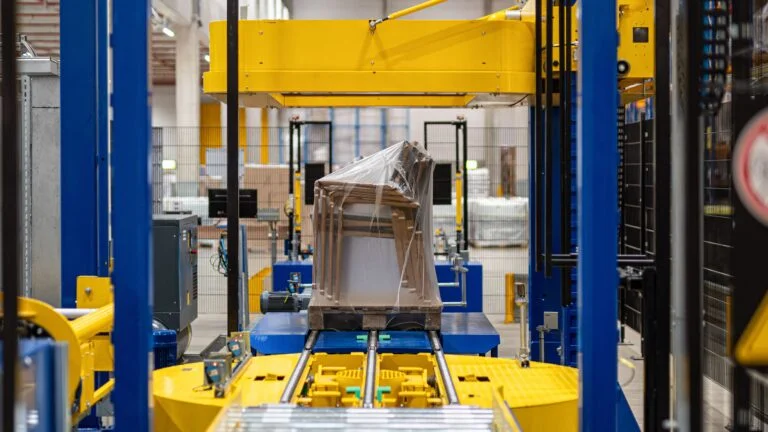
The PPWR defines “packaging” quite broadly. It generally includes items intended to hold, protect, handle, deliver, or display goods. In logistics, therefore, this applies not only to traditional cardboard boxes, but also to things like stretch and shrink wrap, interlayer sheets, labels, adhesive tape, straps, pallets, grid boxes, and other types of transport and protective packaging.
Will the regulation strengthen the trend toward reusable packaging?
The PPWR is driving efforts to increase reuse and improve the recyclability of packaging. This will boost the adoption of reusable concepts in many areas, provided they are environmentally sound, operationally feasible, and economically viable.
DACHSER already offers innovative solutions, such as the DACHSER Retail Box. This specially developed reusable transport system, designed as a rolling container, optimizes efficiency, safety, and sustainability in retail logistics.
At the same time, implementation remains challenging: Packaging solutions must be suited to the specific product, the mode of transport, and the processes within the network.
Gleichzeitig bleibt die Umsetzung anspruchsvoll: Verpackungslösungen müssen zur jeweiligen Ware, zum Transportweg und zu den Prozessen im Netzwerk passen.