The American Revolution wasn’t just political. It was commercial
By Burkhard Eling | 7 minute read
03/07/2026
250 years after the United States became independent, the case for open trade remains strong.

To me, the 250th anniversary of the Declaration of Independence isn’t just another date in the calendar. I called the US home for a few years, living and working on the East Coast. Anyone who’s ever experienced the 4th of July magic with its picnics and fireworks knows how much it means to Americans.
Most people, whether they’ve seen the musical Hamilton or not, remember the Declaration as a political act: a break from British rule, a statement of individual freedom. And yet, the Declaration of Independence is also a declaration of commercial intent. “As Free and Independent States, they have full Power to (…) establish Commerce, and to do all other Acts and Things which Independent States may of right do.”
In other words: On July 4, 1776, America wasn’t just declaring independence. It was declaring itself open for business. How does this relate to our current trade environment?
The American Revolution was, at its core, a trade conflict
As a student of industrial engineering and economics, I was trained to see trade as a system: flows, efficiencies, optimization. But anniversaries like this one bring up a different kind of question: Where did the system actually come from? That’s why, on this special anniversary, I find myself thinking less about fireworks and more about free trade—and freight. What did 1776 mean for the global economy? And what does it mean today?
The American Revolution was, at its core, a trade conflict. The colonies weren’t just tired of British political control—they were locked into a system that told them who they could buy from and who they could sell to. Every economic relationship had to run through London. Anyone who has studied economics or run a business knows that a captive market isn’t a market at all.
Geopolitical tensions and trade conflicts have a direct impact on supply chains. The discussion “Geopolitics at the Loading Dock” highlights the role that logistics plays as strategic infrastructure in this context.
“America First” hasn’t stopped global trade. The numbers prove it
Fast forward to 2026, and the picture looks quite different. The nation that once revolted against trade restrictions is now one of the world’s most aggressive practitioners of them. Tariffs have replaced trade agreements as the primary instrument of US economic policy. “America First” has become, in many respects, “America Alone.” And yet, the world keeps trading.
When I started my professional career as a junior controller at the end of the 1990s, supply chains were far less global than they are today. A disruption in one market rarely had immediate consequences elsewhere. Today, a tariff decision in Washington can affect production planning in southern Germany within days.
I suspect anyone running a business with international exposure has felt this firsthand: The headlines say one thing, the order books often say another. Complexity is up. Costs are up. But the demand to move goods across borders hasn’t gone away.
‘America First’ has become, in many respects, ‘America Alone.’ And yet, the world keeps trading.
The data backs this up. According to the Global Connectedness Report 2026 by DHL and the NYU Stern School of Business, global trade in 2025 grew faster than in any year since 2017. The current US tariff increases are expected to slow that growth down somewhat in 2026, but they will not stop it. Global goods trade is projected to grow at an average of 2.6 percent annually through 2029.
Why? Here are the numbers that put everything into perspective: Only about 13 percent of global imports go to the United States, and only about 9 percent of global exports originate there. The vast majority of world trade has nothing to do with America at all. When the US and China reduce their bilateral trade—as they have, dramatically, from 3.6 percent of world trade at its 2015 peak to under 2 percent in 2025—the trade doesn’t disappear, it just reroutes: Southeast Asia grows, new bilateral agreements emerge, and supply chains adapt.
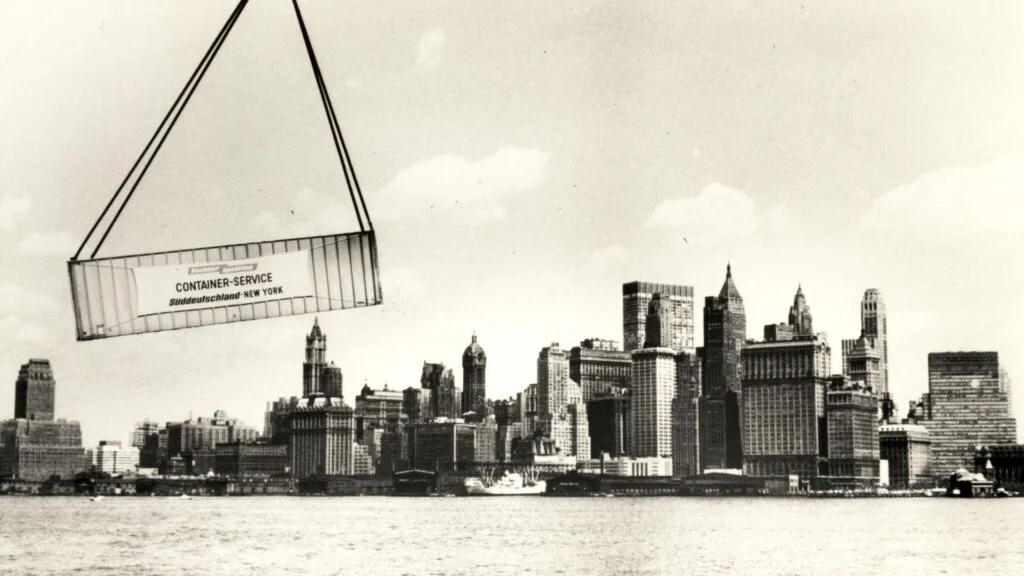
We see this in our own business at DACHSER. We’ve been present in the United States since the early 1970s. What began as a mere sales office in New York became an official subsidiary and operational branch in 1974. Today, we operate ten branches from New York to Los Angeles. We’ve lived through trade wars, recessions, COVID, and now the current tariff cycle. Our volumes between Europe and the US in 2025 are actually slightly higher than the year before. That is, the picture on the ground is more nuanced than the headlines suggest.
+2,6 %
per year through 2029: That’s how fast global trade is growing—despite rising tariffs. Source: DHL Global Connectedness Report 2026
Tariffs create real challenges. How to respond without losing strategic flexibility?
I want to be clear: I’m not dismissing the impact of the current trade environment. Tariffs matter. They add friction, complexity, and cost—costs that ripple through supply chains and eventually reach consumers. For businesses with tight margins and global supplier networks, the current unpredictability is genuinely challenging. For corporations around the globe, it makes planning harder, lead times stretch out longer, and inventory buffers expand.
Many executives I talk to right now are wrestling with the same dilemma: To what extent should they adjust their supply chain today to a highly volatile tariff regime that may change again tomorrow? There’s no clear answer. What I tell my team is that the response to uncertainty isn’t to freeze, but to adapt faster than the rules change.
Trade is not a favor one nation does for another. It is a mutual act of value creation.
Free trade made America great. That lesson shall not be forgotten
The Founding Fathers understood something about trade that we are now seemingly rediscovering. Trade is not a favor one nation does for another. It is a mutual act of value creation. When it flows freely, both sides benefit. When it is restricted, both sides pay a price.
The Declaration of Independence was a bet that freedom, including commercial freedom, would make America stronger, not weaker. That bet paid off. The United States became the world’s largest economy not by sealing itself off, but by integrating into global markets more deeply than any nation before it. History suggests that long-term prosperity isn’t built through isolation, but rather through engagement. That was one of the lessons of America’s rise over the past 250 years, and I believe it remains relevant today.
At DACHSER, our challenge is not to predict every political shift. It is to build organizations that remain adaptable regardless of which direction policy takes next. It’s a challenge we’re ready to take on.