No chance for cargo thieves
By Matthias Rathmann I Reading time: 7 minutes
23/04/2026
Fraudsters are targeting the logistics industry. Cases of cargo theft are increasing. Therefore, the utmost care must be exercised when assigning and handling shipments—both in the hectic day-to-day operations of a dispatch department and when loading direct shipments at DACHSER’s customers’ locations. With a sophisticated security concept and regular training, the company provides high theft protection.

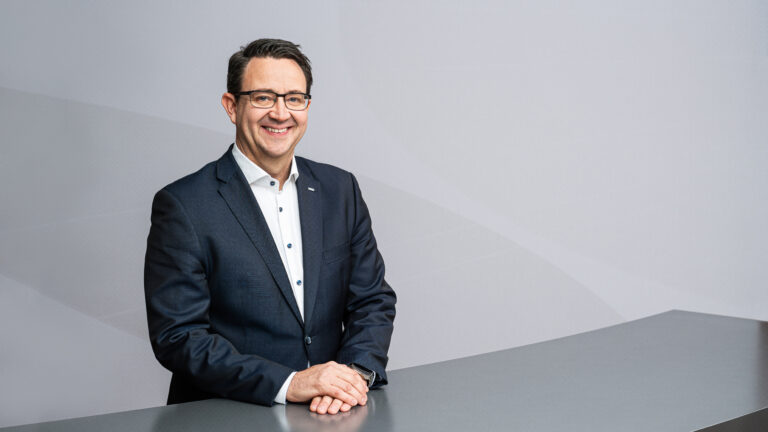
Whether coffee, copper or cheese, sporting goods or smartphones – anything can be lost. Even entire truckloads disappear – almost 26,000 of them annually, as the German Association of Insurers (GDV) estimates. It puts the damage at around 1.3 billion euros a year, adding to that about 900 million euros in follow-up costs. “Nothing is actually safe from theft,” confirms Stephan Wnuck, Department Head Damage Prevention & Data Quality at DACHSER. “Even a complete cargo load of butter can be lost,” the 49-year-old reports. For many years, he has been intensively involved in road safety, first in controlling, then as a team leader and for three years as department head in damage prevention.
Cargo theft is no longer the work of individuals, but of criminal gangs. They come to the country on Mondays, systematically target specific regions and companies and, towards the end of the week, search the vastness with their prey. During this time, they strike at rest areas and trcuk stops, breaking into vehicles and slicing tarpaulins. Germany is one of the hotspots alongside France, Italy, Spain and the UK. This is shown by the caseload of TAPA (Transported Asset Protection Association), the industry association for combating cargo theft, which has committed itself to the highest possible level of security in the supply chain.
Theft has many faces. Tarp slitters who strike at rest areas also continue to do their mischief. However, more and more fraudsters are causing problems for the industry—crooks who use false names and identities to obtain goods under false pretenses. These perpetrators do not resort to the crowbar or the knife, but use the Internet and increasingly artificial intelligence (AI) for their purposes. They are active on freight exchanges as well as in people’s inboxes—using fake email addresses that are strikingly similar to those of real transport companies. These phantom carriers or fake carriers disguise themselves as reputable companies. In reality, they are not interested in the transport service, but in theft. 88 claims by phantom carriers were registered by the German Association of Insurers in the logistics industry in the first seven months of 2025 – the same number as in the previous year. The damage per case: almost 200,000 euros. Because their approach is becoming more sophisticated, dispatchers can easily fall victim to them in the hectic daily business. More than ever, therefore, it is important to check adequately who you do business with.
A check of the vehicle documents with the chassis number of the arriving truck can also be part of the checking process.
Inform and raise awareness among customers
This is where DACHSER comes in with its extensive safety precautions and training measures. This concerns the education of its own employees. On the other hand, Stephan Wnuck is keen to raise awareness among customers of the phenomenon of the phantom carrier. Not all shippers have secured their depots with fences or gatekeepers or installed cameras for surveillance. “This is where we can support and provide assistance,” explains the security expert. He also strongly recommends that customers check which carrier, license plate and driver is involved in direct loading. Loading based solely on a reference number is no longer sufficient. It is essential to verify the data against that of the contracted carrier. It is also legitimate to ask to see the driver’s identification. Shippers can further protect themselves: There are already systems that allow digital storage of the ID card in accordance with data law, explains Stephan Wnuck. He believes it makes sense to also take a close look at the vehicle and its accompanying documents. “Checking the vehicle documents with the chassis number of the arriving truck may also be part of the inspection process.”
It is also important to have contact persons from authorities and all transport participants on hand – in order to be able to act quickly when the emergency arises. Because, as expert Wnuck also says: “Unfortunately, there is no 100 percent certainty. We can’t make it easy for criminals.” He himself is in contact with the authorities, such as the State Criminal Police Office in Saxony-Anhalt, which has set up a “Cargo” task force to put a stop to thieves. In addition, he has been exchanging ideas with other freight forwarders in the Logistics Safety Commission of the German Federal Association of Freight Forwarding and Logistics for ten years, in which the participating company representatives report specific cases and evaluate them anonymously. The panel also develops recommendations for action and strategies to deal with the phenomenon of phantom carriers.
200.000
euros damage per case in the event of fraud by phantom carriers – this is reported by the insurance industry.
Use freight exchanges only in exceptional cases
DACHSER expert Wnuck cites two examples that show the tension between security and speed in which freight forwarding clerks have to move daily. In the company, the requirement applies to use freight exchanges only in exceptional cases. During the so-called Black Weeks as well as during the Easter and Christmas periods, when retailers generate immense demand with discount campaigns, the contractually secured cargo space can also become scarce. Dispatchers sometimes have no choice but to buy freight capacity on the market or freight exchanges.
Also established at DACHSER is a concept for parking in secure parking lots. Those responsible for the respective locations regularly assess the situation on site. This shows: .There are different kinds of secure parking lots. Stephan Wnuck reports on a so-called security parking lot, where the thieves were able to gain access to the parked trucks with their vehicle via a meadow from the other side. If the parking lot, as described, is fenced off only at the front, then the security measures are, to some extent, ineffective.
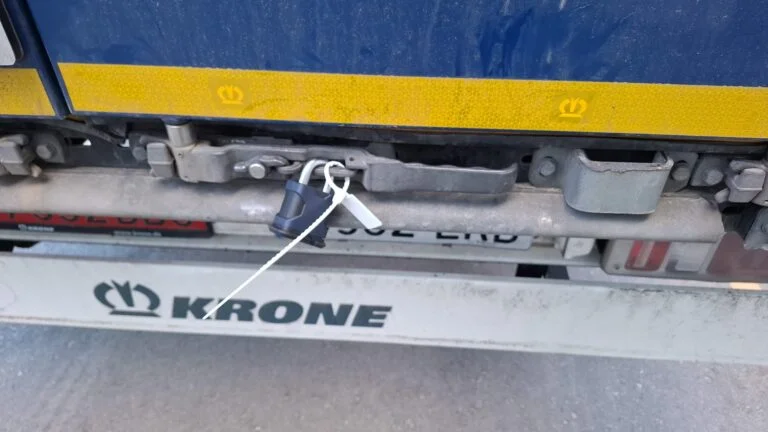
Technically, the goods can already be protected very well, says the trained freight forwarding clerk and studied traffic management – for example by a two-man crew or GPS-monitored bolt locking of the rear portal. However, these safeguards entail considerable additional costs. That is why DACHSER relies on trusted, long-standing service partners and the use of its own fleet for transport assignments. In addition, when handling high-value goods or items at risk of theft above a certain value, employees are required to submit a so-called high-value request or adhere to the corresponding security protocol. They must first obtain the green light from the Head Office in Kempten; in this context, the insurance confirmation of the service partner and the selection of parking lots on the route are checked.
And because criminals are always coming up with new tricks to snatch the goods, dispatchers must always be up to date. Once or twice a year, they participate in internal training and online training – with ever new content, figures and aspects. Because the more criminal energy the organized gangs display, the more important it is to be able to cope with them and their unfortunate activities.
Unfortunately, there is no 100 percent certainty. We can’t make it easy for criminals.
Safety first
DACHSER Principles for safe transport allocation:
- Award only to trusted, long-standing service partners
- Use of freight exchanges only in exceptional cases
- Telephone contact before loading/allocation
- No cargo with high value in the freight exchange
- Sub-contracting of the service partner only after written review and approval