E-mobility: From practical test to blueprint
By Marcus Schick I 8 minute read
16/04/2026
When it comes to e-mobility in logistics, DACHSER is one of the impulse generators in Europe. At three designated e-mobility sites—Freiburg, Malsch near Karlsruhe, and Hamburg—the logistics provider has spent three years researching non-fossil drive technologies and the demands they place on charging infrastructure. A visit to Hamburg yields insights into a pioneering project for the future.

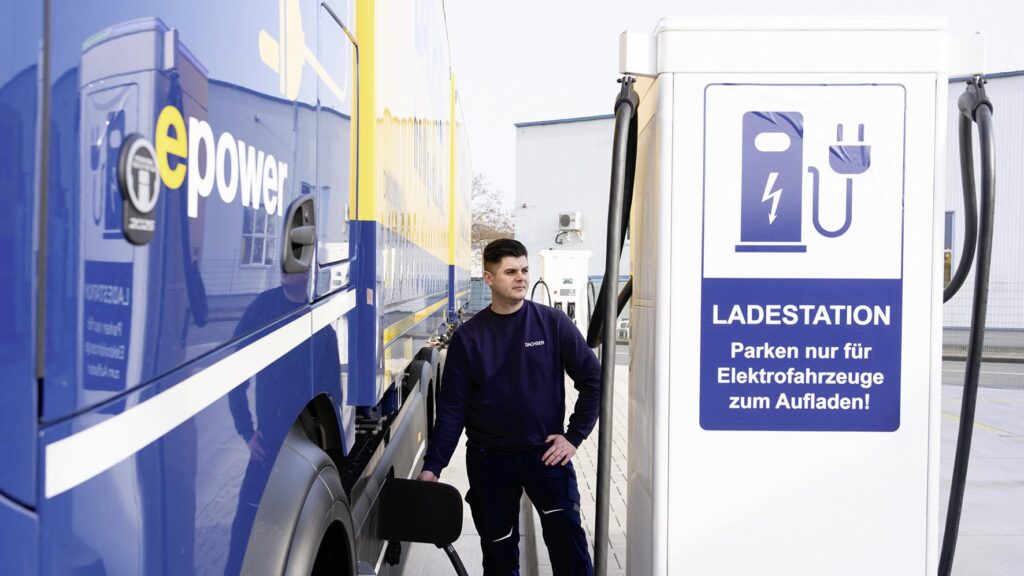
Anyone approaching the DACHSER European Logistics branch in Hamburg from the south can’t help but notice it: a spacious new charging park with parking bays that are specially designed to accommodate e-trucks, offering them power around the clock, seven days a week, at 30 individual charge spots. “DACHSER has been operating one of Hamburg’s largest charging parks for trucks for several months now,” says a delighted Christoph Kellermann, Operations Manager European Logistics at DACHSER’s Hamburg logistics center. However, as is so often the case with electromobility, a lot of pioneering work had to be done along the way.
First of all, DACHSER needed to find space where as many vehicles as possible could recharge at the same time without disrupting ongoing operations. After intensive examination, the decision was finally made in favor of the truck waiting area directly in front of the branch. At the same time, DACHSER also needed to find the optimum arrangement of charging stations to ensure smooth charging for both compact and heavy-duty e-trucks. “It was important that everything mesh well with our operational processes. We’ve also left ourselves room for expansion,” Kellermann adds.
The charging park is another milestone in electromobility at DACHSER. As one of three e-mobility sites in the network, DACHSER Hamburg already has experience with pioneering developments. For example, here’s where the Volvo FL Electric, DACHSER’s 100th e-truck with over 3.5 metric tons total weight, went into operation at the beginning of 2025. “As part of our long-term climate protection strategy, where the focus is on efficiency, innovation, and inclusive responsibility, it was important for us to gain practical experience with zero-emission vehicles at an early stage,” said Alexander Tonn, COO Road Logistics at DACHSER, at the ceremony where the vehicle was handed over. “Nevertheless, there’s a long way to go to make e-mobility economically viable.”
Electric drive research meets everyday freight forwarding
When the first battery-electric heavy-duty vehicles were launched in Hamburg, there was still pioneering work to be done. “We first had to acquire the necessary technological and physics know-how to understand the possibilities and limitations of e-mobility in logistics,” says Ralf Hansen, General Manager of the Hamburg logistics center. The first vehicles still had some teething troubles, which repeatedly led to longer workshop stays and downtimes. As Hansen points out, “That’s a no-go in precision-timed delivery services.”
All the more reason for DACHSER to take a holistic approach to the topic of e-mobility and conduct some in-depth research. So in 2022, the company began to turn its branches in Freiburg, Hamburg, and Malsch near Karlsruhe into “e-mobility sites,” which focused on researching low-emission technologies and processes as well as intelligent electricity and load management, in addition to testing their practical suitability. Dachser massively expanded its grid connections and transformer capacity across all three locations—increasing them fivefold in total. In numbers: The Hamburg European Logistics site went from 630 to 1,500 kilovolt amperes (kVA) and the separately located Food Logistics site from 1,000 to 1,500 kVA; Freiburg and Karlsruhe were each expanded to 2,500 kVA (from 630 kVA previously). At the same time, fast charging concepts with up to 400 kW DC power were developed, as well as load management and billing processes in combination with photovoltaics and a battery storage system.
Since 2022, DACHSER has been researching various aspects of e-mobility in logistics at three e-mobility sites. What’s next for the project? We asked Stefan Hohm, Chief Development Officer at DACHSER.
It was important that everything mesh well with our operational processes. We’ve also left ourselves room for expansion.
Steep learning curve
Kellermann’s team first had to familiarize themselves with the physics realities of working with power capacity at this scale. “We ‘electrified’ ourselves step by step for e-mobility and thus sharpened our technical vision in a steep learning curve,” he says. “When the first larger e-trucks arrived in Hamburg in 2023, we initially had only two charging stations with four charge spots at 180 kW power. If one charging station failed, we couldn’t drive the next day.” Thanks to the new charging park, such bottlenecks are history.
Power supply and load management are key issues for testing at DACHSER’s e-mobility sites. “We need enough electrical power so that the lights don’t go out here or in our neighborhood when we’ve got 150 trucks charging during the day and 70 trucks at night, all at virtually the same time,” Kellermann says. At present, all companies in the Hamburg Moorfleet industrial park are connected to a ring main.
At DACHSER, we want to set a good example here and show our partners ways to achieve both profitability and sustainability.
Attracting young drivers through the driving experience
In addition to such technological/physics topics, DACHSER and the entire industry are increasingly concerned with the issue of driver shortages—and the role that e-mobility can play in this. “Many long-time drivers are skeptical; they don’t trust this new technology and are afraid that an empty battery will keep them from getting to their destination,” says fleet manager Daniel Lewandowski. Younger drivers are more open-minded. “Since 2019, over 50 professional driver trainees have completed their training with us, and we’re currently training 16 more. E-trucks are very popular with them. These young trainees particularly appreciate the relaxed, quiet, low-vibration ride as well as the vehicles’ good responsiveness. There’s real power in play there. Once you’ve driven an electric vehicle, you quickly acquire a taste for it.” Just one problem: Of the 40 carriers and service partners that DACHSER works with in Hamburg, none are currently training professional drivers, and hardly any are operating e-trucks. “At around EUR 270,000, the upfront investment is too high for most companies in these challenging economic times. And with diesel vehicles, you don’t have to buy your own filling station,” Hansen says. “But at DACHSER, we want to set a good example here and show our partners ways to achieve both profitability and sustainability.”
According to Lewandowski, the many years of practical testing of e-mobility have shown a clear forward trend: “Just a few years ago, our e-trucks often had to visit the workshop. But repairing them is a job for suitably qualified high-voltage technicians, who at first were few and far between. If the specialist was sick or on vacation, then the vehicle wasn’t going anywhere. No one in the transportation industry can afford to let their vehicles stand idle. Fortunately, since then there have been huge improvements in workshop service.” Particularly in distribution transport, e-trucks have now proven to be quite technologically mature in day-to-day operations. “Manufacturers are currently focusing more and more on long-distance trucks such as truck tractors or swap-body vehicles, which also save a lot on tolls,” Kellermann says. “Hopefully, they won’t decide at some point to just stop further development work on electric vehicles for distribution transport under 18 metric tons, as these don’t cover enough kilometers of highway for the toll savings to offset the investment.”
50
Since 2019, 50 professional driver trainees have completed their training at DACHSER Hamburg.
As part of our long-term climate protection strategy, where the focus is on efficiency, innovation, and inclusive responsibility, it was important for us to gain practical experience with zero-emission vehicles at an early stage.
From research to everyday logistics
Following the completion of the Dachser E-Mobility Sites project, some important insights have been gained, but many questions remain unanswered. The teams at those sites are currently in the process of compiling all the knowledge and experience gained over three years to create a blueprint for the Dachser network. In Hamburg, the project team is now putting all the pieces of the project picture together at the site. Kellermann has already drawn some conclusions of his own: “E-mobility has arrived in logistics and is here to stay. Even if the road to emission-free transport logistics is still a long one, our e-mobility sites have helped pave the way. This is true not only for Dachser, but certainly for other market participants as well.” For now, it’s crucial to apply this holistic perspective to the development of down-to-earth solutions for everyday logistics.