Resilient supply chains: Working together to keep goods moving
By Marcus Schick I 12 minute read I Photos: Matthias Sienz
05/11/2026
Groupage and food logistics keep industry and commerce running. Even when the economy falters, demand for resilient supply chains and networks remains high. We talked with Stefan Behrendt, Managing Director Food Logistics, and Claus Wetzel, Managing Director European Logistics Germany, about how to get through challenging times.

Is the logistics industry ready for the Christmas season?
Stefan Behrendt: Definitely! For us at Food Logistics, Christmas starts well before December. We get together with our customers early on to make plans, particularly with regard to seasonal product lines, production volumes, and sales promotions. That’s the only way to ensure reliability of supply during the last few weeks of the year. And any items that don’t make it onto the shelves before Christmas usually can’t be sold in January.
Claus Wetzel: We take the same approach in industrial and consumer goods, too. It’s not just about getting children’s eyes to light up; everyone’s gifts need to arrive on time. Take electronic products, for example. The peak season for these starts much earlier. It’s crucial to get products into stores in October and November. We have a lot of experience in this area, and each year we optimize a little more.
At DACHSER, we’ve long known how to handle traditional peak periods. What’s changing right now?
C. Wetzel: The traditional peaks have always been around. Business would pick up before Easter, level off a bit in the summer, and then pick up again as fall approached. That’s still generally the case, but business has become noticeably more volatile and fast-paced. We have to adjust our plans at ever shorter intervals.
No matter what industry customers are in, they don’t just buy transportation and warehousing services from DACHSER. They’re also buying our capability to make deliveries on time and with the highest possible quality.
So does that mean logistics is becoming more challenging?
S. Behrendt: Yes, it is. That’s also because consumer behavior has changed. It’s more and more the case that purchasing decisions are driven by price. As a result, retail promotions are becoming increasingly important. This means shorter planning horizons, greater fluctuations in volume, and a growing need for capacity that can be deployed on short notice. Routes that require only a few vehicles today might need twice as many to be available tomorrow. When that happens, we try to respond as flexibly as possible, but we can’t overload the network either.
C. Wetzel: The more volatile and fast-paced business becomes, the more our customers value reliability and stability. For DACHSER in Germany, this means ensuring a very high level of network stability and on-time delivery. Our advantage here is that we have our own network, which lets central management interact seamlessly with the capable teams at our branches. That lets us control flows of goods in a targeted and efficient manner.
In groupage logistics, fluctuating volumes must be balanced against infrastructure, IT systems, and personnel that must be maintained on a permanent basis. Therefore, robust network structures, standardized processes, and long-term capacity planning are crucial.
Many logistics companies are currently scaling back their truck fleets in response to economic conditions. DACHSER isn’t doing that. Why, and what’s the result?
C. Wetzel: We work very hard to ensure that our customers perceive us as a leader in quality at all times—without any compromises. A key factor in this is our relationship with our service partners and drivers, who are a fundamental part of our supply chain. Four years ago, we launched a service partner initiative, which we’ve now transitioned into a partner management program.
What exactly does it do?
C. Wetzel: The range of topics it addresses is broad and closely tied to real-world practice: What are the best working conditions for our drivers? And what are the best processes in their daily routines? The focus is on fast loading and unloading to make sure that drivers can spend their time driving and with customers. Communication with the drivers is also important.
S. Behrendt: Behind this lies a conviction that stems directly from DACHSER’s core values, namely that we have a responsibility to treat everyone with appreciation and respect. We want drivers who come to DACHSER to find the best possible working conditions. To that end, we also keep in very close touch with our service partners and listen to what they have to say.
When it comes to optimizing workflows, what role does stress at retail loading ramps play? This is often a complicated situation for drivers and dispatchers, with many unpredictable wait times.
S. Behrendt: In the food sector, the situation has improved in some ways because retailers have now also recognized the need to use resources wisely. But there are still many unresolved issues, such as time slot reservations that are too rigid or impractical, or unloading cycles and times that are too long. These often prevent us from planning our operations in accordance with driving time regulations and the capabilities of our network control and route scheduling systems. As a result, potential sometimes goes untapped—both for us and for our customers. That’s why it makes sense for the parties to meet regularly and seek the best possible solutions.
122
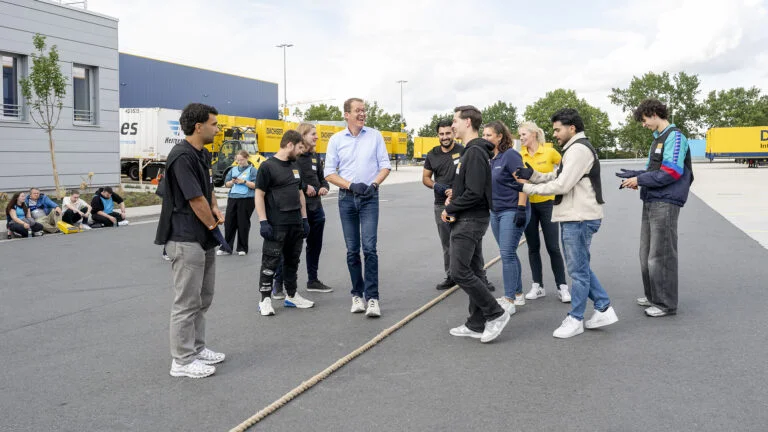
young people began their training as professional drivers at DACHSER this year. The training is provided by DACHSER Driver & Truck Fleet GmbH, a subsidiary specializing in drivers and fleets.
In Germany, DACHSER has recently invested heavily in building new facilities and expanding existing ones. What role does this network expansion play in supply chain security and in ensuring that quality promises are met?
C. Wetzel: For DACHSER, one thing is clear: When it comes to performance, reliability, and quality, we must continually invest in our network, even when that runs counter to economic trends. Investments in our locations are always investments in the strength of our entire network—and thus in our ability to thrive in the future.
S. Behrendt: Additional warehousing and transit terminal capacity boosts the efficiency of our network, which adds real value for our customers. For an easy way to understand the logic, we can take Freiburg as an example. Our European Logistics branch there had established itself very successfully in the market. But recently we had an opportunity to turn it into an integrated facility and use the on-site infrastructure and network for Food Logistics as well. Customers benefit from the fact that we can build on our shared infrastructure and that DACHSER’s long-established, reliable processes reduce complexity and offer clear opportunities for growth.
At such integrated locations, what part does the range of services play—from contract logistics to the export business, including overseas?
C. Wetzel: We offer what our customers need. For example, a U.S. manufacturer might already be selling successfully in Germany, but is now looking to expand its operations further into Italy, France, or Scandinavia. Our integrated locations let us seamlessly link our European services for these customers. We offer a wide range of options that go beyond a simple transportation solution to encompass the entire supply chain.
The expansion in Freiburg demonstrates how existing structures within the DACHSER network can be strategically developed: The Food Logistics division is being added to the established European Logistics branch. Shared infrastructure and well-coordinated processes reduce complexity and create room for further growth.
Investments in our locations are always investments in the strength of our entire network—and thus in our ability to thrive in the future.
E-mobility is increasingly important for DACHSER. How are you rolling it out in the field?
C. Wetzel: We’re systematically pushing ahead with e-mobility and working with all of our branches to develop the right solution for each location: What’s the available power capacity at the branch? What about charging infrastructure? How many electric trucks can we accommodate at our charging stations, and at what power output? By answering questions like these, we can immediately put our overarching strategic goals into action. After all, there’s no one-size-fits-all solution here—especially given huge variations in grid connection capacity from branch to branch.
We’ve described the current challenges in great detail. Where do you see your respective business units five years from now?
S. Behrendt: We see that the markets are changing rapidly, that our customers are constantly evolving, and that they’re always looking to tap into new sales markets. Added to this are geopolitical challenges, the struggle for raw materials and resources, and an ever-changing landscape of regulatory approaches. Navigating this environment and proving yourself time and time again is, and always will be, the greatest challenge, both for our customers and for DACHSER. But the good news is that our resilient network puts us in an excellent position to do just that, which means we can move forward into the future together with our customers. We want to, and we will, be there for our customers as an impulse generator and an innovator, as an active and proactive shaper of supply chains and procurement—today, in five years, and beyond.
C. Wetzel: Germany has a heavyweight consumer market and, despite the economic slowdown, we remain an industrial powerhouse. And even though in recent years we’ve had to deal with a stagnating market environment, I see enormous opportunities for DACHSER. Not least because we’ve recently made some major acquisitions in Europe. We can support our customers as they expand internationally. Wherever our customers are, we’re there too: not only in Germany and Europe, but also in China, India, North America, and everywhere in the world that globalization is making its mark. That’s exactly why I’m so optimistic about the future at DACHSER, because I’m firmly convinced that we’re focusing on the right things.