Why Research and AI Are Becoming Increasingly Important for Logistics
By Christian Auchter | Reading time: 6 minutes | Lead photo: Niklas Hesser
04/11/2026
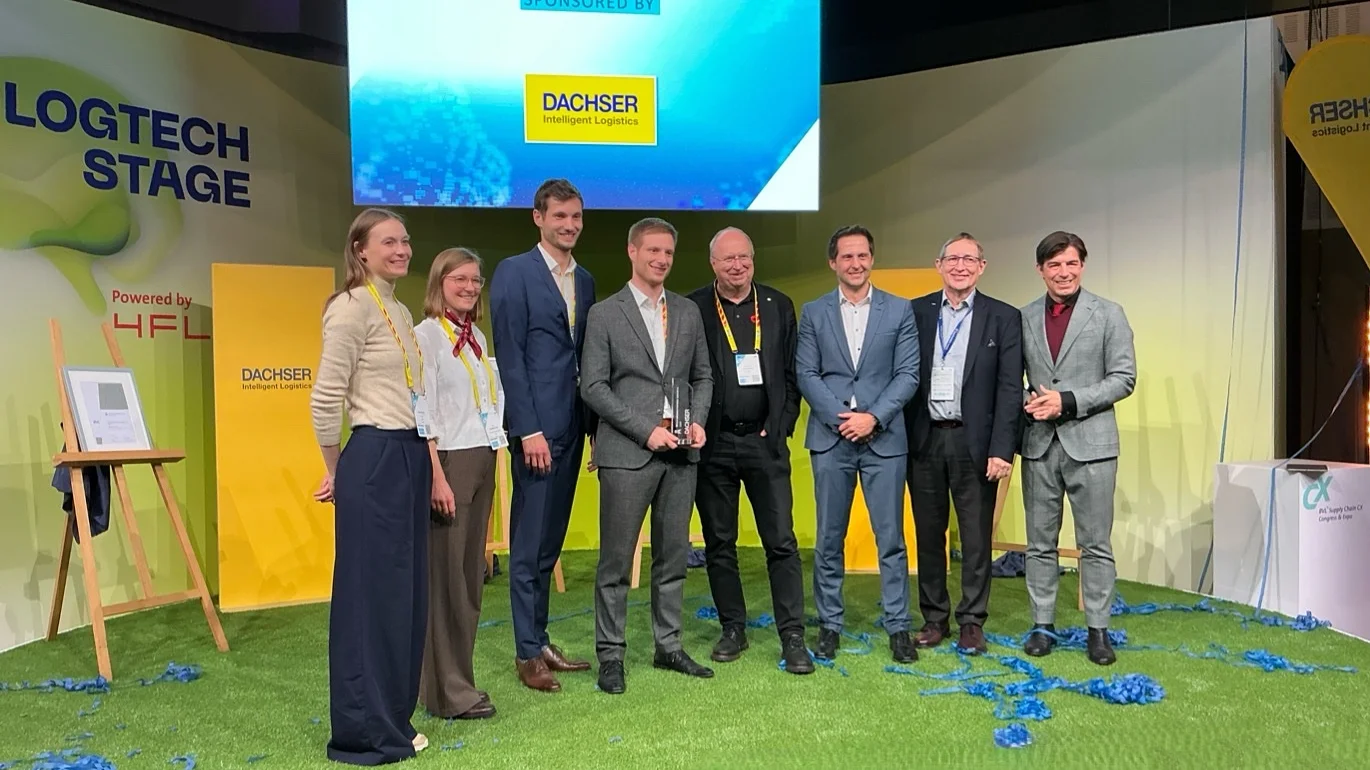
The DACHSER-sponsored Logistics Science Award was recently presented at the BVL Supply Chain CX logistics conference in Berlin. The prize, worth 5,000 euros, honors scientific work that provides new impetus for practical applications. In an interview, Stefan Hohm, Chief Development Officer (CDO) and member of the Executive Board at DACHSER, explains why research plays an important role for the company, how innovations emerge, and the significance of artificial intelligence in this context.

Why does DACHSER support the Logistics Science Award?
Stefan Hohm: The Logistics Science Award from the BVL (Bundesvereinigung Logistik) brings together topics that are of great importance to us: practice-oriented research, innovation, and the promotion of young talent. The award provides young scientists with a major, high-profile platform to present their outstanding work to practitioners in the logistics industry.
This year’s winner also demonstrates just how important the practical relevance is for the Science Award. Timo Lehmann was honored for his research on performance evaluation of automated multi-depth warehouse systems and on the comparison of different operating strategies. His work addresses questions that constantly occupy us in our day-to-day logistics work: What concepts can we use to increase our efficiency, and which technology is best suited to which requirement?
Science can provide sound decision-making support for such questions. That is why close cooperation with the research community has been an integral part of DACHSER’s innovation process for many years.
How does innovation work at DACHSER in practice?
S. Hohm: Through our Corporate Research & Development division—which we established at DACHSER ten years ago—we’re able to identify relevant technology and trend topics early on and develop practical solutions. We have already demonstrated this in numerous areas of digitalization, as well as in electric mobility and innovative urban delivery concepts.
In addition to our own expertise, we also rely on close innovation partnerships with technology providers, startups, scientific institutes, and, of course, our customers. In doing so, we not only focus on concrete, practical solutions but also look to the future: What relevant technology and market trends will influence our customers’ supply chains and our role as a logistics service provider in five to ten years? This involves many aspects of supply chain resilience. At the same time, both our customers and we must grapple with a megatrend that, in various forms, will lead to profound changes in supply chains: demographic change in many societies. Logistics will be affected primarily by the shortage of skilled workers, but possibly also by shifts in the flow of goods and information. We must prepare for these and other trends today, develop ideas for innovative solutions, and implement them at the right time.
In doing so, we deliberately draw on the knowledge and ideas of our employees. Our Idea2net innovation and idea management program plays an important role. The best innovations often emerge where our employees work with customers, processes, and challenges on a daily basis. With Idea2net, we collect and evaluate ideas from across the entire company and translate them into concrete projects and improvements for our network.
The DACHSER Enterprise Lab also plays a central role in our innovation management. Here, logistics specialists from DACHSER conduct research together with scientists from the Fraunhofer Institute for Material Flow and Logistics (IML) and the Fraunhofer Institute for Intelligent Analysis and Information Systems (IAIS). Promising ideas—including those from Idea2net—are further developed here and translated into concrete solutions that are then implemented in pilot projects. One result of this research partnership, for example, is our award-winning digital twin @ILO, which has proven itself in practice and is now being gradually rolled out across our major branches.
We will continue this successful collaboration in the coming years, with a particular focus on digital solutions, artificial intelligence, and robotics.
From locally emission-free downtown deliveries and smart tracking devices to AI applications and the digital twin @ILO: An overview shows how DACHSER has tested new technologies and integrated them into logistics practice over the past ten years.
Innovations in Logistics: Highlights from the past ten years >
AI is transforming our work, research, and innovation, but it does not replace the human ability to make sense of contexts, take responsibility, and draw the right conclusions.
What role does AI play in research and innovation?
S. Hohm: In my view, the pressure to innovate has never been as high as it is today—and not just in the logistics industry. The vast potential of artificial intelligence opens up new perspectives and shapes the innovation agenda of many companies. This makes it all the more important not to let this momentum pass us by, but rather to actively help shape it. As a company, we do not pursue a separate AI strategy, but rather view AI as an integral part of our innovation and digitalization strategy. Our innovation management framework provides us with a solid foundation for exploring the possibilities of AI and putting them to practical use.
Specifically, our current focus is on developing and deploying agents that can take on repetitive tasks—for example, in administrative processes—whether fully automated or as assistants to make manual processes more efficient. The challenges here are the quality of the AI agents’ outputs and the costs—because every token used costs money.
However, despite all these possibilities, people continue to play the decisive role. Sometimes the impression arises that AI is supposed to take over our thinking. I am convinced, however, that the exact opposite is true. More than ever, we need in-depth engagement with a topic, clean and methodical work, clearly defined processes, and a keen eye for practical application. AI is transforming our work, research, and innovation, but it does not replace the human ability to make sense of contexts, take responsibility, and draw the right conclusions.
At the same time, AI can also create space for the human spirit of innovation. It helps us reduce routine tasks and free up more time for new ideas, inspiring thoughts, critical thinking, and innovation.