A Big Wheel: The Pallet Market Under Pressure
By Marcus Schick I 8 minute read
20/04/2026
They carry goods, secure supply chains, and keep logistics running—Euro pallets. With millions in circulation, they are considered an integral part of everyday life in industry and commerce. But this certainty is beginning to waver: A and B grades, which are particularly needed by the food industry, are becoming increasingly scarce. This is because the pallet cycle is under pressure—with repercussions for costs, planning reliability, and delivery capacity along the entire supply chain.

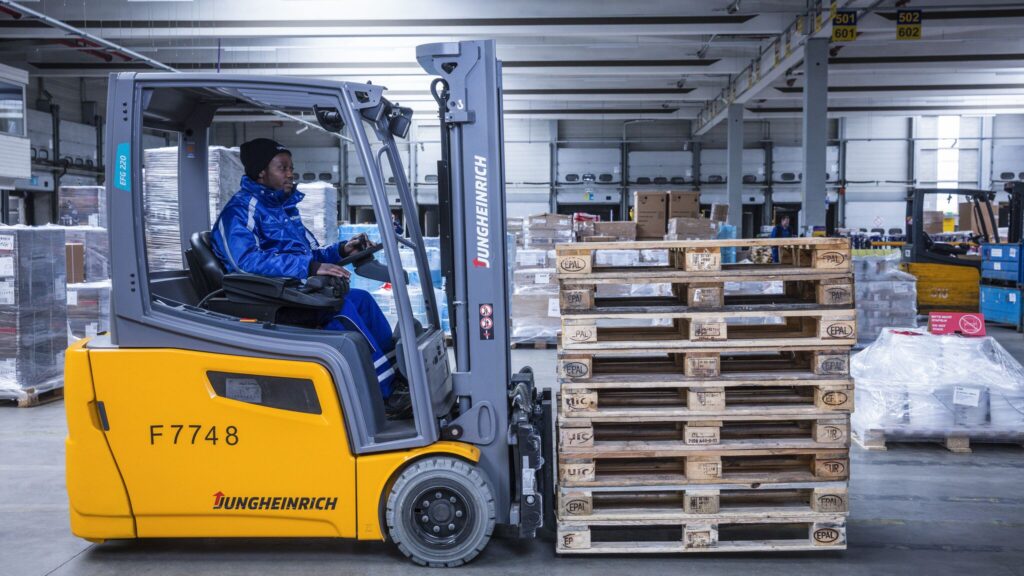
9 wooden blocks, 11 boards, and 78 nails. 1,200 millimeters long, 800 millimeters wide, 144 millimeters high, and weighing 22 kilograms: The worlds of logistics and transportation are inextricably linked to the Euro pallet. It carries not only goods and merchandise but also entire business models along extensively branched supply chains. This is one reason why the pallet market in Germany is among the most competitive in Europe. “Every company that ships goods should treat its load carriers just as carefully as the actual product being sold,” says Philipp Kreuzer, Department Head of Packing Aid Management at Dachser.
A system out of balance
This is also why the pallet cycle in Germany and other European countries is today a finely balanced exchange system—one that is, however, coming under increasing pressure. Depending on the region, there are significant differences in pallet availability—ranging all the way to outright shortages.
This is because the traditional 1:1 exchange at the loading dock—a pallet of goods for an empty pallet—has largely become obsolete, especially at the central warehouses of large retailers. Instead, the exchange is increasingly handled by pooling service providers such as CHEP, IPP, LPR, PAKi, inter.PAL, or DPL. They maintain pallet accounts and have established settlement systems with credit notes. Dachser also works with such service providers. “Booking instead of driving has many advantages. However, when the physical return of pallets is decoupled from the accounting settlement—this is offset by a systemic disadvantage,” says Philipp Kreuzer. After all, a balance in the account does not replace an actually available, high-quality pallet in the right place at the right time. “Yet this is precisely what leads to delays, a quality ‘mismatch,’ and additional management requirements.”
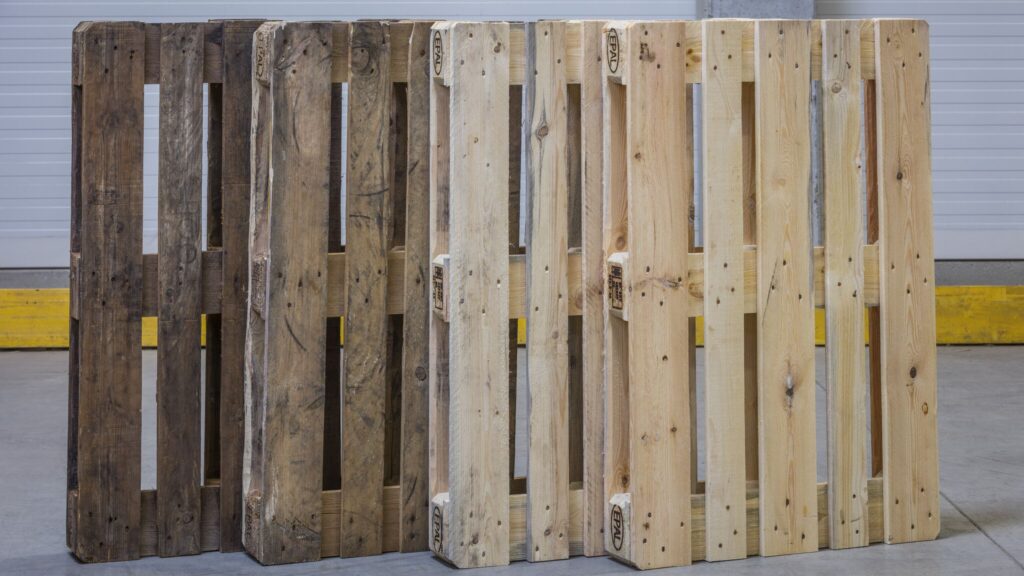
This is becoming an increasing challenge along supply chains, especially when various factors converge. For example, a lack of transparency regarding the location and quality of individual pallets, the occurrence of regional imbalances, time lags between delivery and the physical return of pallets, as well as quality losses in circulation while simultaneously requiring an upgrade. In food logistics, for instance, A and B quality are the standard for pallets: that is, light-colored, clean, and largely undamaged load carriers. Things get tricky when the delivered pallet quality cannot be returned accordingly, and instead, an increasing number of lower-quality pallets are returned to the cycle—and in some regions, these are sometimes no longer even available, further exacerbating the time lag.
The demand for high-quality pallets has generally risen significantly.
Quality becomes a bottleneck
“The demand for high-quality pallets has generally risen significantly,” says Kreuzer. “This is also due to the fact that these pallets can be handled better and more safely by automated systems and stacker cranes, which are being used in more and more warehouses.” Yet it is precisely these qualities that are becoming increasingly scarce in the pool of pallet service providers; instead, there is a growing need for repairs, a high scrap rate, and a severe shortage of high-quality A/B-grade pallets.
“In the system, there aren’t enough of these sought-after high-quality pallets available,” notes Philipp Kreuzer. But when high demand meets low availability, this always results in greater effort and rising costs. If a “pallet voucher” replaces a direct physical exchange, says Kreuzer, it sounds practical at first because it eliminates the need for “empty” transport and subsequent large-scale storage upon delivery. The pallet debts can be settled later.
But: “The pallet voucher does not replace the physical pallet; it is – and remains – ‘merely’ a billing reference—without the certainty of getting a high-quality pallet back,” sums up Stefan Krautwurst-Leister, Head of Sales Food Logistics at Dachser. “In day-to-day operations, the actual bottleneck – the physically available pallet in the required A/B quality – remains. This then becomes a problem for the other participants in the exchange cycle, especially for the food industry. If this causes the entire system to become excessively expensive, logistics service providers will ultimately be forced to pass the costs on to customers or consider alternatives to reliably ensure their supply chain with the pallet quality they require.”
A/B-grade
pallets are in greater demand than ever—partly due to increasing automation.
The pallet voucher does not replace the physical pallet; it is – and remains – ‘merely’ a billing reference—without the certainty of getting a high-quality pallet back.
The Logistics Service Provider as Coordinator
In this complex structure, Dachser plays a central role for its customers. “We are in constant communication with shippers, recipients, retailers, and pooling partners to balance the interests of all parties,” says Volker Seidel, who heads the Pallet Service Pooling team at Dachser alongside Philipp Kreuzer. “We take a neutral stance in packaging exchange and manage the packaging comprehensively, digitally, and professionally. At the same time, we are deeply affected and challenged to find solutions for our customers.” More than 400 employees across the company handle packaging management throughout Europe. They manage inventories, monitor accounts, organize settlements, and ensure that pallets are available where they are needed. The effort involved is considerable. And it is growing steadily.
A key factor here is the intelligent management of the pallet exchange system. Under the guiding principle of “Booking Instead of Driving,” the goal is to organize pallet movements as efficiently as possible and avoid unnecessary transport. Digital systems, regular inventories, and close monitoring help balance surpluses and demand within the network.
For customers, this development isn’t always immediately visible. “Pallets aren’t a service that’s actively noticed—as long as everything works,” says Volker Seidel. But that’s precisely where the challenge lies: “A functioning packaging exchange isn’t a sure thing; it’s the result of a complex interplay. “We’re turning a really big wheel here at Dachser Packaging Management. And this wheel can only turn if everyone involved plays their part.”
Transparency and Shared Responsibility
As it continues to build an effective packaging management system, Dachser continuously analyzes and revises all relevant processes. And it always does so in close collaboration with customers, retailers, and pallet pooling partners.
But for Philipp Kreuzer, one thing is clear: “In a highly complex market segment like pallet exchange, maximum pallet availability in top quality cannot be achieved alone.” As a major customer, Dachser therefore maintains a good, close relationship with packaging service providers. “We are in constant, intensive communication with their experts. This supports and strengthens mutual understanding and contributes to better planning and cost transparency for both sides,” explains Philipp Kreuzer.
However, it is also clear that a voucher does not transport physical goods. For that, the “classic” Euro pallet of the highest possible quality is still needed. Philipp Kreuzer adds: “All players in the system must do their part: through careful handling of the pallets, transparent processes, and close coordination throughout the entire supply chain. Because only when the foundation is right will the rest of the logistics run smoothly. There are enough pallets on the market for this.”
However, it is also clear that a voucher does not transport physical goods. For that, the “classic” Euro pallet of the highest possible quality is still needed. Philipp Kreuzer adds: “All players in the system must do their part: through careful handling of the pallets, transparent processes, and close coordination throughout the entire supply chain. Because only when the foundation is right will the rest of the logistics run smoothly. There are enough pallets on the market for this.”