Intelligent and sustainable: Logistics location of the future
By Marcus Schick I 11 minute read
13/05/2026
In February 2026, a pioneering new logistics center commenced operations in Unna, Germany. The new location puts sustainability front and center, with a clear focus on automation, e-mobility, energy efficiency, and the people who bring logistics to life.

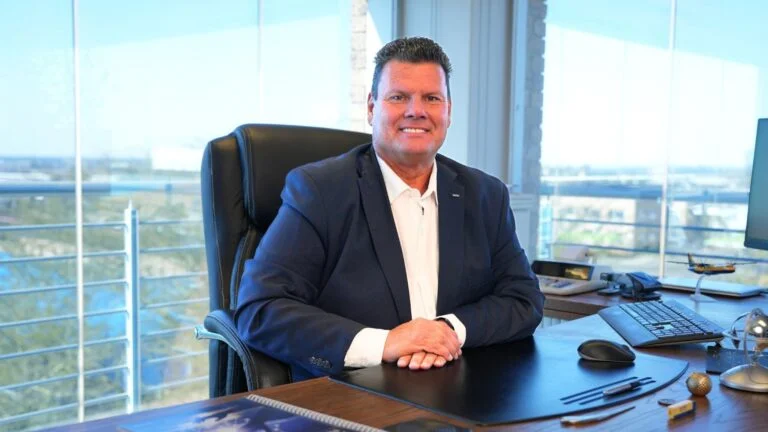
The scenic southeast corner of the German state of North Rhine-Westphalia is called Sauerland. Its people are (in)famous for their stubbornness, but in fact, they really just want to live and let live, and certainly don’t try to talk anyone into anything. Local literary historian Ulrich Raulff claims to have discovered a particular trait of the Sauerlanders: he terms it “conservative liberalism” with an openness to the possibilities of the future. One proud native of Sauerland is Jürgen Sobkowiak, who found his passion in logistics. For more than 27 years, he’s been active in the North Rhine-Westphalia Transport and Logistics Association and has sat on its board for over eight years. He’s also been General Manager of Dachser’s logistics center in Dortmund since 2011.
With its strategically favorable location in the heart of the broad-based Rhine-Ruhr economic region, the Dachser site in Dortmund has long been one of the most important hubs in the company’s European network. Dachser opened a satellite branch of the Neuss branch in Dortmund back in 1952; this became the Dortmund branch in 1974–75. Twenty-five years later, in 2000, the company moved to its current location at Huckarder Strasse. “The existing branch’s capacity to handle the continuously increasing shipment growth had reached its limits, so the decision was made to ‘divide the cell,’ as it were. A new, modern branch was to be integrated into the Dachser network in nearby Unna,” says Sobkowiak, summing up the story. This was also good news for him personally, as Unna had become his adopted home during his training in freight forwarding and his first few years on the job.
Decisions for the network
When designing and building the new branch in Unna, Dachser had in mind the future viability not only of the location but also of the network. “Our focus is on further consolidating the groupage network and expanding capacity in a future-proof way,” explains Alexander Tonn, COO Road Logistics at Dachser. “Automation, e-mobility, and energy efficiency are three key pillars for the Dachser branch of the future. Such branches will pool central technologies, be sustainable, and strengthen our network both operationally and strategically.”
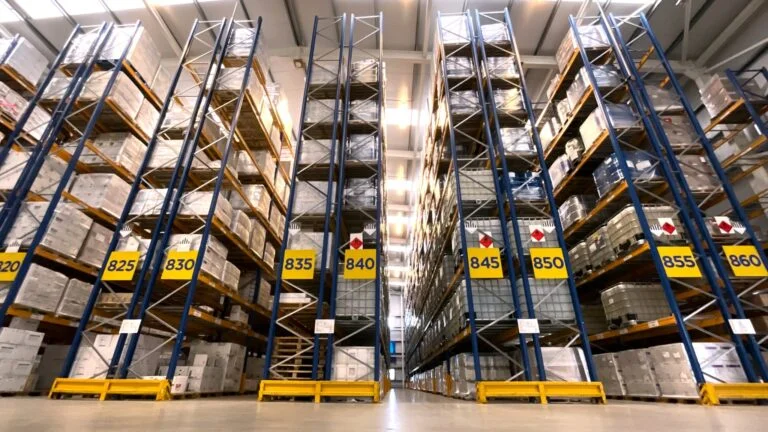
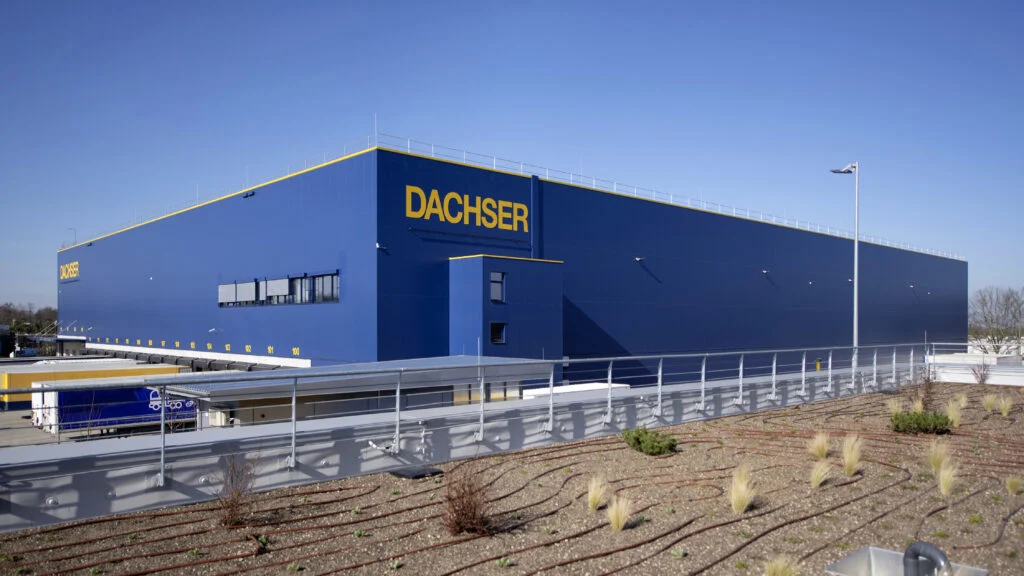
In Unna, some 25 kilometers east of Dortmund, this pioneering approach for the European Dachser network was implemented under the leadership of the Corporate Real Estate division at Dachser Head Office. “But it’s not just a showcase,” Tonn is careful to point out. “It’s a chance for us to implement the best of what’s possible today in operational and practical terms, what makes sense, and what’s going to pay off in the future.” The site features a 9,400 m2 transit terminal with 94 gates, a multiuser warehouse with an area of 10,800 m2 and 22,000 pallet spaces, as well as a 3,500 m2 office building. It was built using the brownfield approach on land in an industrial park that had previously been built upon. Around 96 percent of the demolition material could be directly reused; the majority of it was reinstalled right on the construction site under quality control.
The EUR 44 million invested in the new site, which finally went into operation in February of this year, represents one of Dachser’s largest single investments in its overland transport network. As a highly experienced branch manager, Sobkowiak assumed a key role in the construction and network integration. This was due not just to his freight forwarding expertise, but also to his openness to e-mobility and future technologies. He knows just how to combine these as an “in-house entrepreneur,” with a clear view of profitability and the challenges of logistics.
44m
euros were invested in Unna to build the new facility.
Our efforts in climate action and our strategic approach are and will thus remain relevant sales arguments in the market.
The home field advantage
When Sobkowiak talks about the new branch, he always expresses a deep-seated enthusiasm for logistics and a conviction of its future viability. He knows that his “home field advantage” in Dortmund and Unna will help him spread this spark to his team. At the logistics location of Unna and the surrounding area, word has long since gotten around among specialists and customers alike: “We can work with the people at Dachser.”
But the new construction also raised another question: What defines the Dachser branch of the future? In a word, sustainability. Even if it has recently taken a back seat in public discourse, sustainability continues to play an important role as a decision-making criterion at Dachser—despite the increased cost pressure. “Large companies among our customers have clear expectations due to their own sustainability goals, and they want their logistics providers to have a clear commitment to sustainable and responsible action. It’s a prerequisite for being considered for tenders at all,” says Dachser CEO Burkhard Eling. Accordingly, the company’s climate protection strategy is geared toward the areas of process and energy efficiency, research and development, as well as Corporate Citizen+, meaning commitment beyond the core business. “In everything we do, it’s important to always understand the customer’s individual requirements, both in terms of climate action and service quality, so that we can offer them the right solution,” he adds.
Automation, e-mobility, and energy efficiency are three key pillars for the Dachser branch of the future.
Focus on efficiency in core operating processes
With this as a foundation, Dachser operates its integrated network of locations throughout Europe with uniform quality standards, comprehensive procurement and distribution networks, and standardized equipment. “This concept of ‘the industrialization of processing’ enables us to systematically increase capacity utilization and productivity in all countries. That’s because the greatest levers for increasing productivity lie in operational core processes, which account for around 85 percent of costs in the groupage business,” Tonn says.
At the same time, this places high demands on a branch’s structural and procedural infrastructure. In the Corporate Real Estate division at the Head Office in Kempten, Dachser experts take the latest findings from research and development and combine them with decades of experience in branch design.
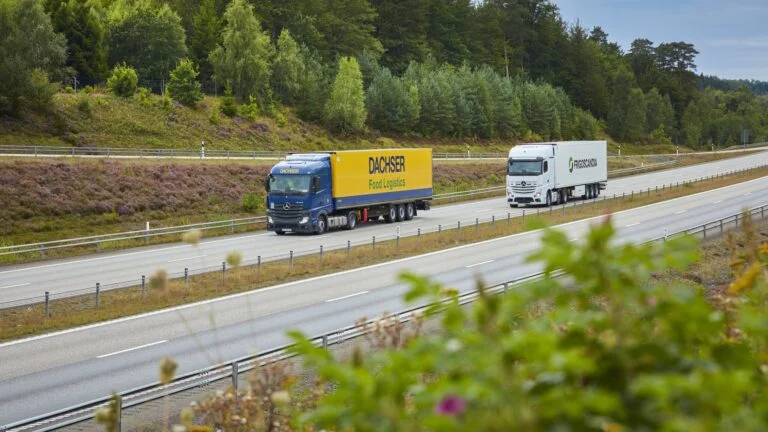
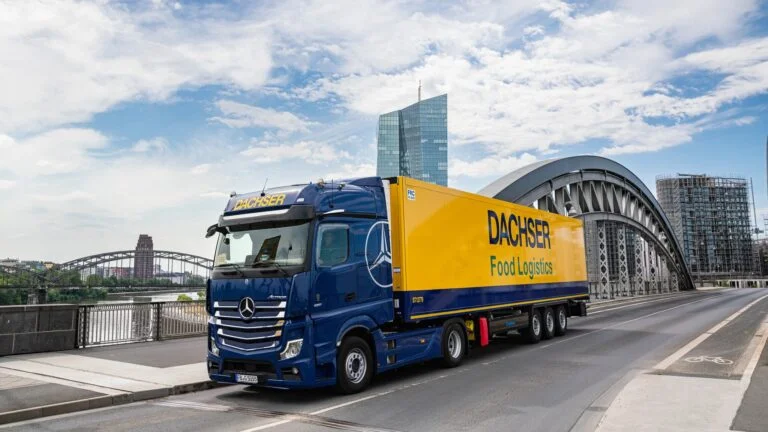
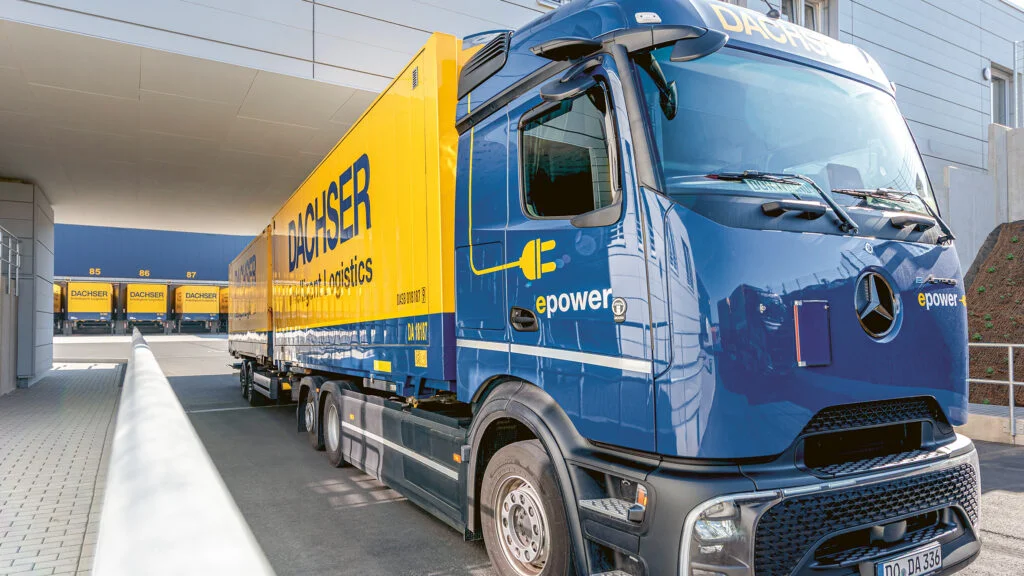
The structural requirements, for example with regard to e-mobility, result from Dachser’s overarching strategy and operational processes. As part of its efforts to protect the climate, the company is currently deploying around 190 battery-electric trucks in its European network. “The majority of our e-trucks are used in short-distance transport, especially in our DACHSER Emission-Free Delivery areas in 25 major European cities,” Tonn says, adding that the number of e-trucks in long-distance transport is increasing rapidly as well. Most recently, these were extensively tested at Dachser’s three e-mobility sites in Freiburg, Hamburg, and Malsch near Karlsruhe.
“The branch in Unna is a lighthouse project for us,” Eling says. “We use state-of-the-art technologies and AI-based systems, while at the same time further expanding the infrastructure for electromobility. In this way, we’re setting standards for future viability and sustainability.”
From the very beginning, the new facility in Unna was designed with electric mobility in mind. DACHSER is finding more and more uses for electric trucks. They are now also being used for long-haul transport.
Built to order
However, there were a few hurdles to overcome along the way. Construction took place on the site of a former automotive supply warehouse. Its topography, with a 6.5-meter height offset, and noise protection requirements meant that the planning phase was particularly challenging and tailored solutions had to be developed. For example, the access road to the transit terminal runs under the office building. “Added to that were the skyrocketing construction prices, especially after the COVID-19 pandemic. Every construction decision, no matter how small, was scrutinized twice,” Sobkowiak reports. “But we cooperated well with our construction partners and always worked to come up with solutions together, even if construction ended up taking a little longer than originally planned.”
Many technical and structural innovations, such as heating, cooling, and control technology, remain hidden, while others are clearly visible. For example, the green roofs on the transit terminal and the office building provide natural cooling and air conditioning effects on the inside while naturally adding value for biodiversity on the outside. Another example is the wooden substructure roof trusses, the first that Dachser has installed.
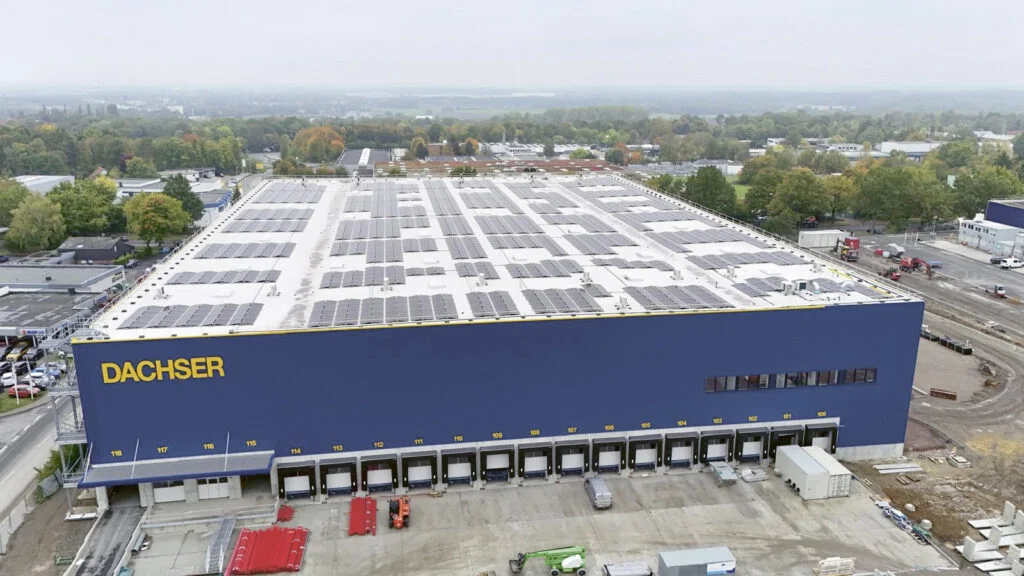
Photovoltaic modules with an output of 1,000 kWp have been installed on the multiuser warehouse, contributing to the 100 percent green energy supply in the Dachser network. Charging options for cars and trucks were also taken into account: In addition to twelve charging stations for cars with the option to expand to 50 more charge spots, several charge spots for e-trucks are currently being completed. Five of these are intended for fast charging with up to 400 kW. “Unna will soon also be operating Dachser’s first megawatt charging station,” Sobkowiak says. This is possible because Unna’s municipal utility supplies the branch site with a connected load of 3.9 megawatts.
Air-to-air heat pumps provide virtually emission-free heating and cooling inside the office, warehouse, and cargo handling areas. Instead of radiators on the walls and underfloor heating, the heat comes from faceted ceilings above. Thanks to their large surface area, they can heat the space efficiently even with a very low flow temperature.
Digital twin boosts efficiency in cargo handling
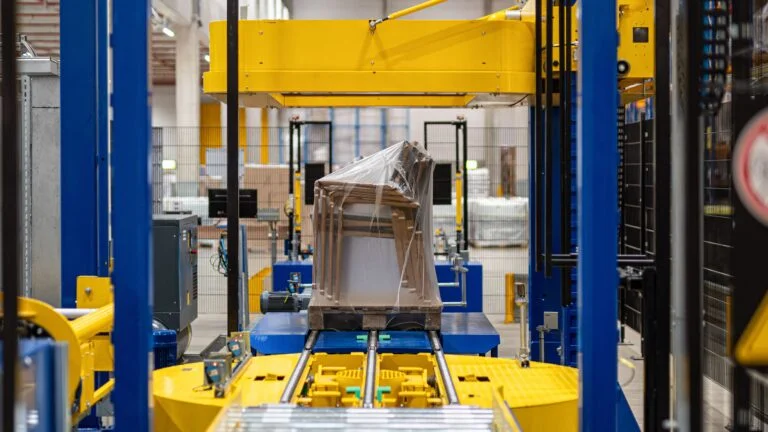
“Our new logistics center is also innovative and future-proof in terms of digitalization,” Sobkowiak says, pointing to the optical scanning units fitted to the terminal’s ceiling. The sophisticated technical equipment is an essential component of the @ILO digital twin in the transit terminal. This technology, which has won awards in competitions in Germany and recently at the European level as well, enables packages to be identified, localized, measured, and recorded in the transport management system fully automatically when they enter and leave, as well as during their stay. “It’s an innovation with which Dachser is making history,” says Sobkowiak. “We’re one of the first branches in the Dachser network to roll out this pioneering technology. It speeds up processes and ensures greater transparency in the groupage terminal.”
In the future, autonomous transport vehicles known as AMRs will be used in the warehouse opposite the transit terminal. These mobile robots navigate through the aisles and perform repetitive tasks such as storing and retrieving pallets at ground level. This relieves the strain on employees, who then have more time and availability for various additional services, such as packing assortment boxes or promotional packs, labeling, special packaging, assembly, or display builds.
Our employees are and will remain our greatest asset.
Logistics by people, for people
For Sobkowiak, the quality and safety of activities in day-to-day logistics are vital to the success of a branch and the associated network effects. “Our employees are and will remain our greatest asset,” the branch manager says. This is also clearly reflected at Unna. “It’s simply wonderful to see how a special, highly functional logistics center has been created here that invites both employees and customers to achieve great things together.”
But before he gets too euphoric, the man from Sauerland pulls back. He doesn’t want or need to convert anyone to an enthusiasm for innovation. “The Unna logistics center speaks for itself,” he says. In February, he handed over operational management of the branch to Steffen Strüver, a seasoned and experienced expert from Dachser’s own ranks in Dortmund—a down-to-earth and hands-on leader, in true Westphalian style. But that’s another story for another day.